
Why Assassin's Creed Shadows' Most Hated Feature is Actually Its Secret Sauce
Let me tell you something, folks. In the wild, wacky world of 2026 gaming, where every other open-world title is trying to out-bloom the last with map markers that could give you anxiety from the main menu, Assassin's Creed Shadows stands out like a well-placed hidden blade. I know, I know. Saying a Ubisoft game is genuinely good and has something to teach the industry is like saying you enjoy pineapple on pizza—controversial, but hey, someone's gotta have the good taste. After a few years where Ubisoft's rep was deader than a Templar after a leap of faith, Shadows felt like a real turning of the page. It didn't reinvent the wheel, but man, did it polish it, balance it, and send it rolling down a beautifully curated Japanese hillside.
The game tackles a ton of open-world fatigue head-on. We're talking dynamic seasons that actually change how you play, side content that doesn't feel like a chore list from hell, and a map that gently guides you instead of screaming "GO EVERYWHERE NOW!" But the real kicker, the feature that had players typing angry essays faster than you can say "微交易," is its level gating. And guess what? I'm here to die on this hill. I think it's one of the best design decisions in the game.

For the uninitiated, level gating basically means certain areas of the map are a big, fat 'NOPE' until you've leveled up enough. You can technically waltz in there, but you'll get smacked down quicker than a rookie at a yakuza poker game. Especially playing as Naoe early on, where combat is more 'surgical precision' and less 'button-mash victory,' venturing into a high-level zone is a recipe for a quick reload. This, my friends, is a feature, not a bug.
Here’s the tea: Open-world games have had a serious 'choice paralysis' problem for years. You boot up a game, see a map the size of a small country dotted with a thousand icons, and your brain just goes 'nope, I'm out.' It's overwhelming AF. Shadows uses level gating as a gentle, yet firm, guiding hand. It says, "Hey, focus on this beautiful chunk of Japan first. Get to know it. Master its rhythms. The rest will come." This is crucial because Shadows sends you on these broad, almost detective-like missions to hunt down targets. Without that focus, you'd be chasing shrine foxes in one province while the main plot thread unravels in another, leaving you feeling totally detached from the story.
Why This 'Restriction' Feels So Good:
Let's break it down with a handy-dandy list:
-
Fights Overwhelm: Instead of being consumed by the sheer scale the moment you step outside, the world expands as you grow. It feels earned.
-
Creates Aspiration: Seeing a high-level area on the map isn't a daunting checklist item; it's a goal. A challenge to come back to. It's emergent storytelling—"One day, I'll be strong enough for that castle."
-
Paces the Narrative: It stops you from grinding side quests for 20 hours and completely forgetting why you're in Japan in the first place. The story maintains a semblance of pace.
Now, level gating isn't new. Old-school RPGs like Gothic built entire worlds on it, and the whole Metroidvania genre is basically elegant ability-gating. But in the modern "go anywhere, do anything" open-world landscape, it's become a dirty word. Shadows proves it shouldn't be.
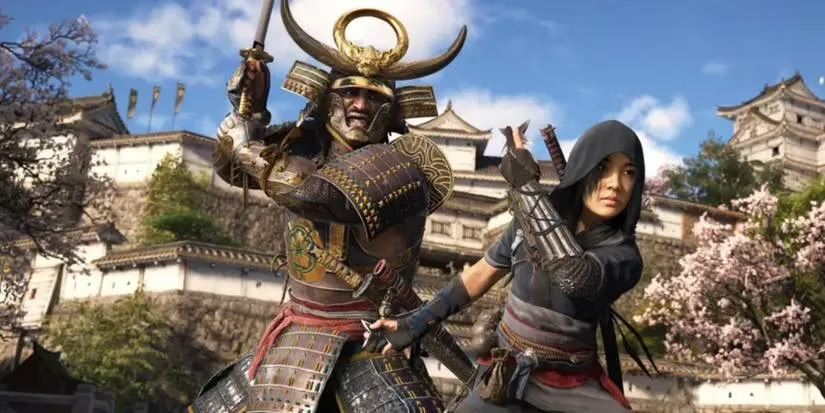
Compare it to something like Elden Ring. That game scatters brutally tough bosses everywhere to keep the challenge high. But in many other open-world games, the bandit in the first zone feels about as threatening as the bandit in the last zone—just with more health. Boring! Level gating solves this by creating tangible power differentials. That enemy who one-shotted you at level 5 becomes a satisfying victory dance at level 25. That's a feeling, people!
Sure, there are other methods. Ghost of Tsushima unlocked parts of the island per story act, which was clean and effective. But for a game with Shadows' more loose, investigative structure, that rigid geographical lock wouldn't fit as well. It also lacks that sneaky, "I shouldn't be here" thrill of venturing into a high-level area, getting a glimpse of the danger, and noping out with a new personal goal.
| Method | Game Example | Best For | The Vibe |
|---|---|---|---|
| Level/Stat Gating | AC Shadows, Xenoblade Chronicles | Loosely structured narratives, player-driven exploration | "This is my own personal nemesis mountain." |
| Story Act Gating | Ghost of Tsushima, Horizon Forbidden West | Tight, linear narratives with clear geographical divisions | "The story will tell me when I'm ready." |
| Ability Gating | Metroid Dread, Hollow Knight | Exploration-focused worlds where movement is key | "I need a new toy to get past this." |
Look, Assassin's Creed Shadows isn't perfect. But its take on level gating? Chef's kiss. 👌 It makes the world exciting, gives you tangible goals beyond the checklist, and saves your poor brain from melting from too much freedom too soon. It's a masterclass in 'less is more' world design.
So, to all the future open-world titles out there: take a page out of Shadows' book. Not every game needs it, but if you want to avoid overwhelming your players and make your world feel truly progressive and alive, a little thoughtful gating might just be your secret weapon. It's about curation, not just creation. And in 2026, that's a lesson worth learning.
Comments