
Tiny Details That Make Assassin's Creed Shadows Unforgettable
When fans of the long-running franchise finally stepped into feudal Japan through Assassin's Creed Shadows, they were met with breathtaking landscapes, deep dual-protagonist gameplay, and a story that kept them glued to the screen. The game quickly earned its place as one of the best entries in years. But while sweeping samurai duels and stealthy shinobi takedowns are impressive, something far more subtle steals the show. It’s not the grand set-pieces or the flashy combat—it’s the avalanche of tiny, painstakingly crafted details that truly bring this world to life. 📸
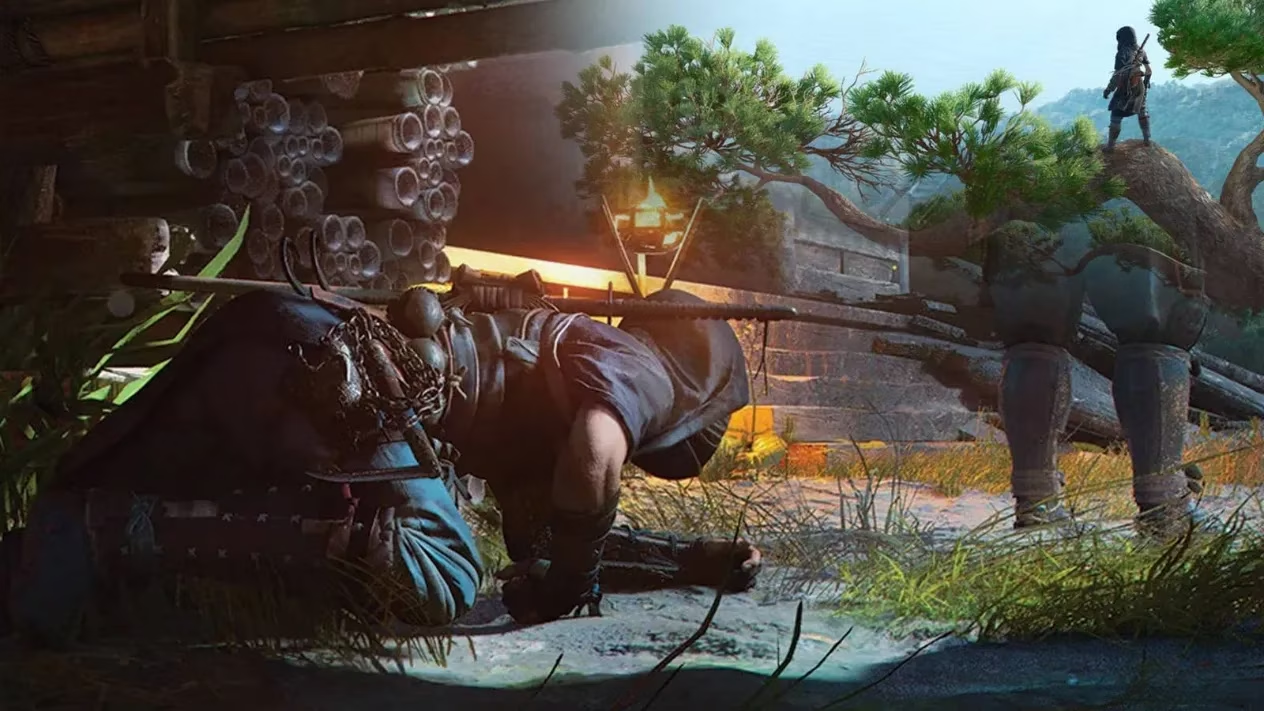
As you wander through the dense bamboo forests or explore bustling villages, it’s easy to rush past and never stop to admire the smaller touches. But if you pause, you’ll notice just how much care Ubisoft poured into the environment and its inhabitants. The result is an open world that feels less like a playground for assassins and more like a living, breathing version of 16th-century Japan.
One of the first things that grabs your attention is the weather system, which has been enhanced by the game’s dynamic seasons. Winter, for example, isn’t just a cosmetic change. Snow accumulates in massive drifts, and as you trudge through it, your feet leave authentic trails—just like in the real world. ❄️ After a heavy snowfall, it doesn’t simply disappear when the sun comes out. Instead, the snow melts in real time, shrinking hour by hour and revealing the ground beneath. This gradual transformation makes the world feel persistent and responsive.
But snow is only the beginning. Rain transforms the landscape in equally impressive ways. Sandy riverbanks darken as the water saturates the ground, and puddles form realistically on uneven terrain. Bodies of water ripple and churn during storms, and strong winds visibly bend tree branches and scatter loose foliage. Even more striking, when you defeat enemies near a lake or stream, their blood actually spreads and dilutes in the water, staining it temporarily. 🌊 These are the kinds of details that don’t just look good—they make every moment feel cinematic and unscripted.
The physical world isn’t the only element treated with such respect. The two protagonists, Naoe and Yasuke, feel utterly distinct not just in combat but in how they interact with their surroundings. Naoe, the agile shinobi, can scale walls, leap across rooftops, and perform the series’ iconic Leap of Faith with practiced ease. In contrast, Yasuke’s sheer bulk as a samurai means he cannot climb most structures. His attempts at parkour are clumsy; he might grab a ledge but fail to pull himself up. And if he tries a Leap of Faith? He simply stumbles off the edge in a comically ungraceful tumble before crashing into the haystack below. 😂 This isn’t just a gameplay limitation—it’s a brilliant character choice that reinforces Yasuke’s role as an outsider in a world built for shadows.
The NPCs around them enhance this contrast further. While common folk barely glance at Naoe, they take immediate notice of Yasuke. Citizens bow respectfully as he approaches, step quickly out of his path, or simply stare at the towering stranger in their midst. In a few moments, the game communicates his elevated samurai status and the reality of being a foreigner in this era, all without a single line of dialogue. It’s a small touch, but it adds a profound layer of immersion that many open-world games miss.
Beyond these spotlight features, countless other micro-details lie scattered across the map. Bamboo sways individually in the breeze, insects gather around lanterns at dusk, and different types of footwear leave unique prints on soft ground. Some players have even noticed that the two protagonists hold their katana differently when sheathed, reflecting their distinct training backgrounds. Even after months of exploration—and with 2026 now upon us—fans continue to unearth new secrets, a testament to the depth Ubisoft wove into every corner of this virtual Japan.
Post-launch updates have only deepened this richness, adding seasonal events and fine-tuning environmental effects. As patches roll out, something as simple as morning frost or cherry blossom petals falling in spring becomes even more mesmerizing. It’s a reminder that Assassin's Creed Shadows isn’t just a product of its time; it’s a living game that keeps on giving.
All of this combines to deliver an adventure where the journey matters as much as the destination. The big moments—storming a castle, assassinating a target—are thrilling, but the quiet ones stick with you. Standing on a hill as twilight paints the rice paddies gold, watching a village come to life after a monsoon, or simply noticing a child giggling as you trip over an icy rooftop. That’s where Assassin’s Creed Shadows truly shines. It’s a masterclass in world-building, and if future titles follow its example, the franchise has an incredibly bright—and remarkably detailed—future ahead. 🌟
Comments