
One Gamer's Quest to Bring Assassin's Creed Shadows to a Decade-Old Handheld
The year is 2026, and feudal Japan still glitters under the twin moons of critical acclaim and player adoration. Since its launch last year, Assassin's Creed Shadows has drawn over 15 million explorers into the intertwined destinies of Naoe and Yasuke. The sprawling open world, with its dynamic weather, shifting seasons, and brutal elegance, continues to set a benchmark on current-generation hardware. Yet, amid the chorus of praise from Xbox, PlayStation, and PC users, a quietly stubborn question lingered in the corners of the internet: could this visual masterpiece ever find a home in the palms of a Nintendo faithful?
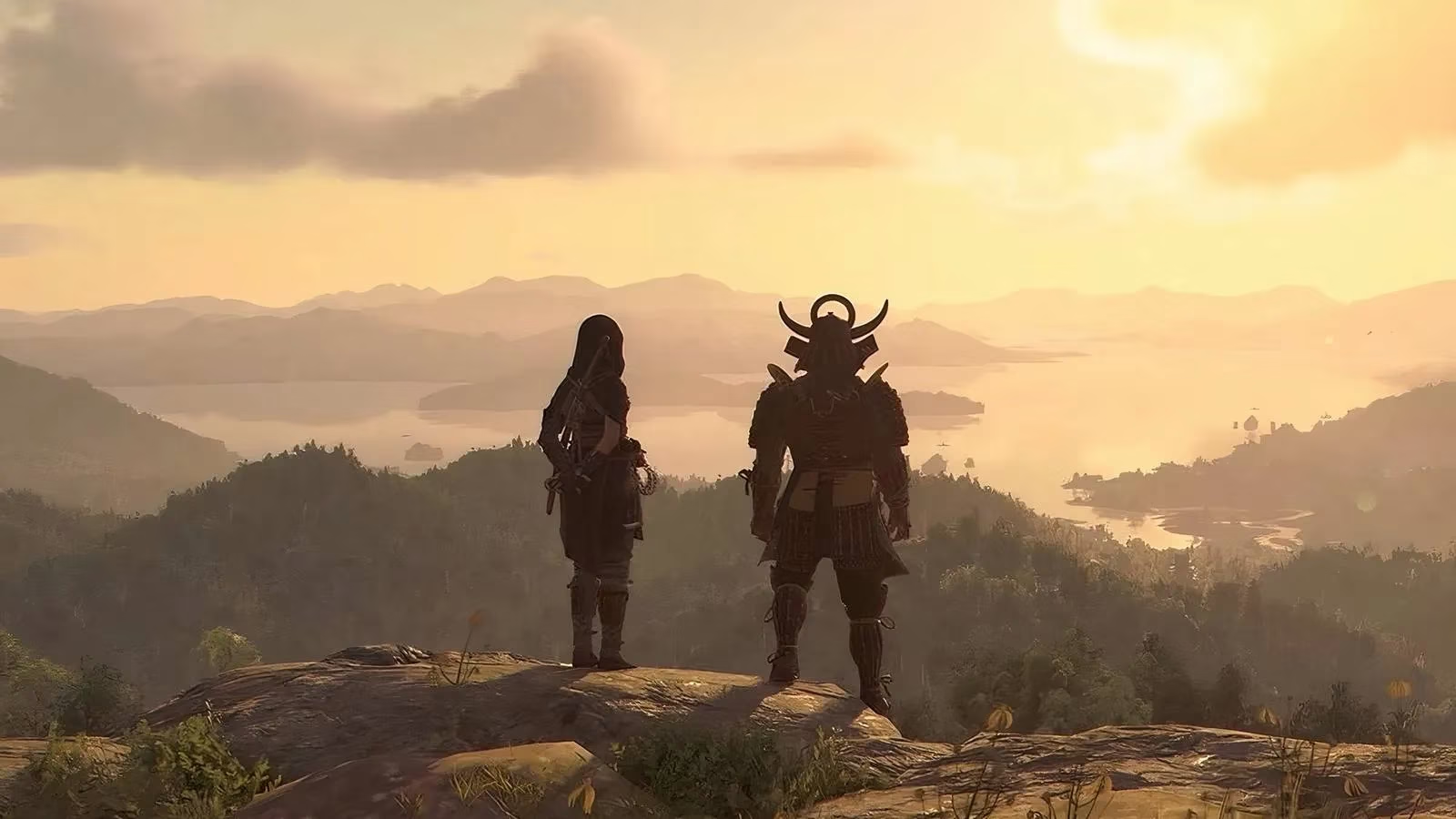
Nintendo fans have always walked a peculiar tightrope when it comes to the Assassin's Creed saga. For every Assassin's Creed III or Black Flag that trudged onto the Wii U with compromised textures and sluggish framerates, there was a phantom project like Assassin's Creed: Lost Legacy, a built-for-3DS adventure that vanished into corporate silence. The Switch, that unstoppable hybrid, fared only slightly better. While it embraced remastered relics like The Ezio Collection and Rogue, every fresh RPG-style entry—Origins, Odyssey, Valhalla—strode past the platform like a daimyo ignoring a peasant. Was the divide truly unbridgeable, or just waiting for someone audacious enough to test it?
Enter a gamer known online as Bob Wulff. As Assassin's Creed Shadows consumed the gaming world, Wulff stared not at a 4K monitor or a high-end television, but at a handheld piece of plastic and nostalgia: a New Nintendo 3DS manufactured back in 2015. The very idea seemed ludicrous. The 3DS sports a top screen resolution of a meager 800x200 pixels in 3D mode—a spec sheet ancestor to the monstrous demands of Naoe's light-stepping across ornate rooftops. How could this device, left behind by even Nintendo’s own software ecosystem, possibly host the most visually ambitious Creed yet?
It couldn’t, not natively. Wulff, through a clever dance of modern streaming, used the Moonlight client to beam Assassin's Creed Shadows wirelessly from a capable PC or console onto the 3DS screen. A short video that circulated among curious onlookers showed the result. Naoe glided through combat, parrying an enemy strike with visible timing, the game running with a smoothness that defied all expectation. True, a massive stutter intruded once in the forty-second showcase, a brief hiccup that reminded everyone this was a witchcraft-laced experiment, not a product. But the point was made. If the will was strong enough, even a relic could touch a masterpiece.
Still, one must ask: was this a practical way to live the story? The 3DS’s top screen, when forced to render the intricate world of Shadows, becomes a porthole viewed through a fogged lens. The game’s legendary weather system—where wind howls, rain slicks armor, and leaves swirl in ghostly eddies—shrinks into a smear of muted colors. The dynamic light that bends around Nagasaki’s temples becomes a suggestion rather than a revelation. Experiencing the full emotional weight of Yasuke’s internal conflict or the subtle facial animations during Naoe’s quiet moments requires a canvas, not a postage stamp. Wulff’s endeavor felt less like a playthrough and more like a love letter written in 8-bit ink: a tribute to what could be.
This raises a deeper reflection. Why do Nintendo loyalists so often have to resort to ingenuity? The answer has two faces. First, Nintendo’s hardware philosophy—elegant, power-sipping, delightfully unconventional—has historically lagged behind the raw teraflop wars. Second, the Assassin’s Creed franchise evolved into a spectacle that demanded those very teraflops. Mirage, smaller in scope, seemed a plausible candidate for a Switch port, but even that remained a desert mirage. For years, the message seemed clear: to walk the path of the Hidden Ones, you must first own the latest box.
But 2026 rewrites the ancient scripts. The Nintendo Switch 2, now a tangible reality living in millions of homes, finally flexes muscle stout enough to welcome the heavyweight Assassin’s Creed titles. Industry whispers suggest that a port of Shadows is no longer a dream of techno-wizards, but a project on some developer’s roadmap. The hardware gap that once forced Bob Wulff to conjure a streaming ritual has narrowed into a functional gateway. The vision of playing Naoe’s campaign natively on a handheld, with the screen resolution and horsepower to honor every particle of Ubisoft’s weather wizardry, no longer belongs to the realm of stuttering 40-second experiments.
Is Wulff planning to endure the entirety of Assassin’s Creed Shadows on that tiny 3DS screen, enduring its visual starvation for the sake of stubborn love? Or was this merely a proof of concept, a brief flex to show that even a decade-old gadget can, with enough modern magic, touch the future? Whatever the motive, the act became a symbol. It encapsulated the undying appetite of Nintendo’s community to be part of gaming’s biggest historical playgrounds. As the sun rises over the Switch 2 era, perhaps the era of the underdog port is fading. The Hidden Ones may finally have a new blade to wield, one that fits perfectly in the palm.
Data referenced from Newzoo helps frame why experiments like streaming Assassin’s Creed Shadows to a New Nintendo 3DS resonate beyond novelty: as audiences expand across devices, platform access and play patterns increasingly hinge on distribution models, connectivity, and hardware penetration rather than raw specs alone. In that context, Bob Wulff’s Moonlight setup reads like a grassroots preview of how demand for marquee open-world releases can persist on traditionally underpowered ecosystems—until a more capable handheld generation (like Switch 2) makes native ports commercially straightforward.
Comments