
How Assassin's Creed Shadows Finally Breaks the Open-World Repetition Cycle
Repetition has been the silent assassin of the Assassin's Creed series for nearly two decades. From the original game’s endless eavesdropping and pickpocketing loops to the copy-paste forts and bandit camps sprawled across Origins, Odyssey, and Valhalla, the franchise has always struggled to keep its massive worlds from feeling like glorified checklists. In 2026, with Assassin's Creed Shadows now firmly part of the series’ legacy, it’s clear that Ubisoft finally found a way to make exploration feel dangerous, dynamic, and deeply rewarding again. The question isn’t just whether Shadows succeeded where others stumbled—it’s how a game set in feudal Japan redefined what an Assassin’s Creed open world can be.

The History of the Repetition Problem
The very first Assassin's Creed introduced players to Altaïr’s Holy Land, but the mission structure quickly grew stale: pickpocket, eavesdrop, interrogate, repeat. Brotherhood gave us a breathtaking Rome, yet climbing tower after tower to unlock districts became a familiar chore. Even Black Flag, beloved for its naval combat, drowned players in endless tailing missions that slowed the pirate fantasy to a crawl. As the series shifted into the open-world RPG era with Origins, the maps ballooned in size, but the activities inside them started to feel eerily uniform. Whether players were clearing a fort in Egypt, a camp in Greece, or a monastery in England, the rhythm rarely changed—mark, infiltrate, kill captain, loot chest, move on.
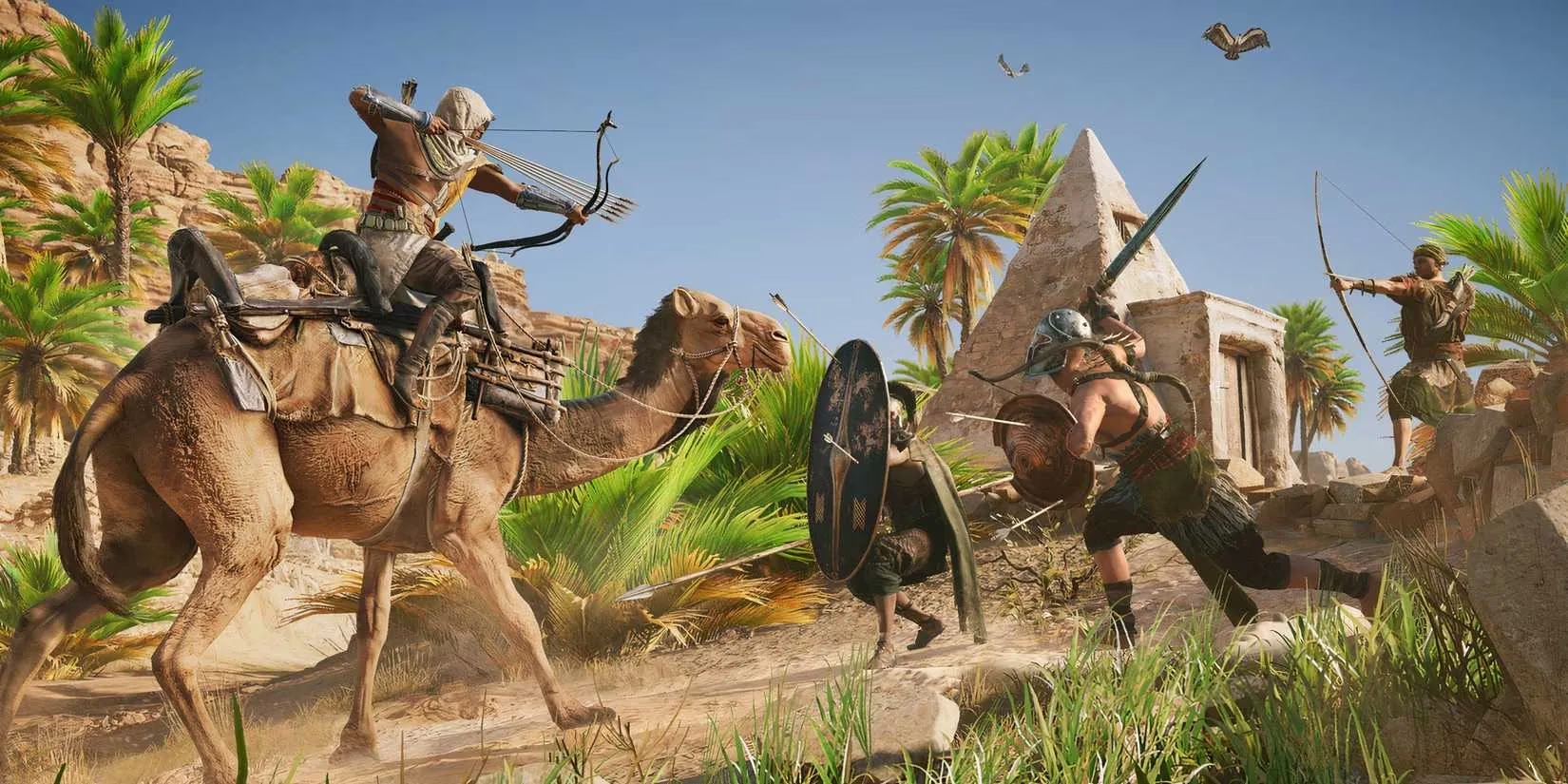
This isn’t to say those games weren’t enjoyable. The combat grew tighter, the landscapes were gorgeous, and the stories often hit emotional highs. But the sense of discovery fades when every location feels like a reskin of the last. What players really crave is a world that reacts to their actions, where moment-to-moment gameplay doesn’t just repeat itself but evolves based on environment, tools, and choice. That’s exactly the pivot Shadows made—and it’s a lesson the whole industry should be studying in 2026.
Stealth Steps Out of the Shadows (Literally)
The most transformative change in Assassin’s Creed Shadows is how it elevates stealth from an afterthought to the heart of the experience. In earlier RPG entries, sneaking was often an optional, slightly undercooked path you could take before inevitable open combat. Shadows flips the script. The game doesn’t just encourage stealth—it makes it feel alive.
Dynamic lighting is the star here. Hiding isn’t just about crouching behind a crate; it’s about manipulating darkness itself. Players can snuff out lanterns or wait for cloud cover to extend a shadow’s reach. But the world pushes back: a guard might light a torch and suddenly your safe corner vanishes, or dawn could break mid-mission, flooding a courtyard with sun and forcing a frantic scramble for new cover. This isn’t a static puzzle—it’s a living back-and-forth that demanding constant adaptation. How many other open-world games in 2026 can claim to make the rising sun a genuine gameplay threat?
Weather gets equal billing. Rain masks the sound of footsteps, letting Naoe sprint across gravel without alerting nearby samurai. Mud, on the other hand, slows movement and leaves tracks. The environment isn’t just a backdrop; it’s an ally and an obstacle that shifts minute by minute. Even tiny details—blood spatter on armor, mud accumulating on clothing—ground the player in the moment and make every infiltration feel unique. Memorizing patrol routes helps, but you’re never fully in control. And that unpredictability is precisely what slams the door on repetition.
Two Protagonists, Two Philosophies
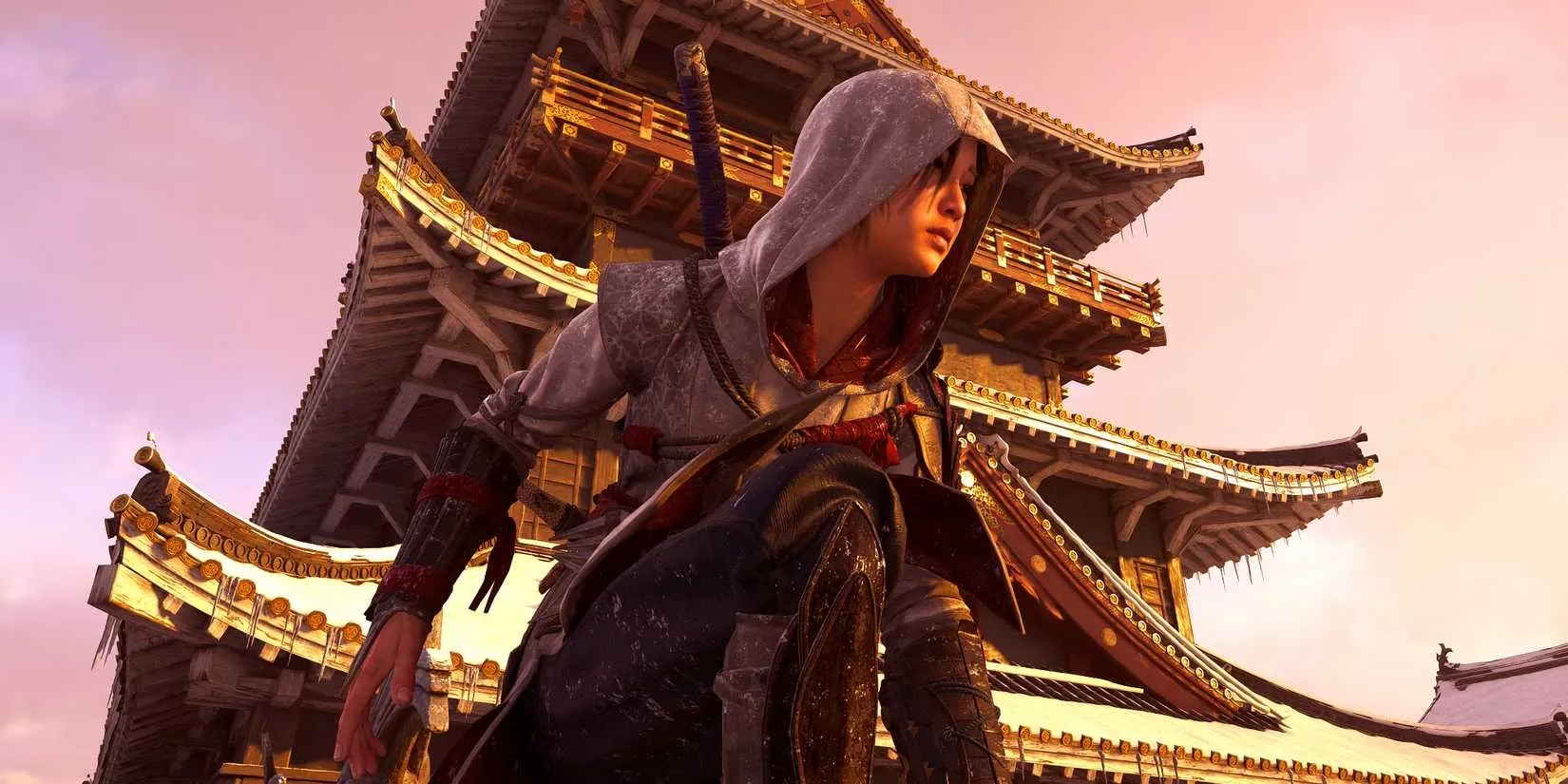
The dual-character setup of Naoe and Yasuke deserves a lot of credit for keeping things fresh. Unlike Syndicate’s Jacob and Evie, whose differences often felt cosmetic, these two define entirely different playstyles. Yasuke, the imposing samurai, can attempt stealth but excels in brutal, stand-your-ground combat. Naoe, the nimble shinobi, is built for the shadows—she climbs faster, hides more easily, and dispatches enemies with quiet precision. The game never forces you to pick one permanently; you can switch freely, which means a single mission can be approached from two radically different angles. Returning to a familiar castle as Yasuke after clearing it as Naoe feels like playing a different level altogether. This built-in variety is a powerful antidote to the \u201cone-size-fits-all\u201d design that made clearing outposts in previous games feel so monotonous.
A Blueprint for the Future
With the success of Shadows now a known quantity in 2026, it’s worth asking: what lessons should future Assassin’s Creed titles take away? First, bigger isn’t always better. A smaller, handcrafted map with layered environments and meaningful verticality invites more creative play than a vast, flat countryside dotted with identical activities. Mirage hinted at this, and Shadows proved it. Second, systems-driven stealth—where light, sound, and weather matter—should become the series standard, not a one-off experiment. Finally, bringing back classic mechanics like social stealth and crowd blending could deepen the fantasy even further. Imagine stalking a target through a bustling market in a future title, losing yourself among merchants and monks, knowing that one wrong move could send lanterns swinging and alarms ringing.
Assassin’s Creed Shadows didn’t just launch a new historical playground; it rewired how players interact with that playground. By making stealth a reactive, high-stakes dance instead of a binary choice, it turned repetitive checklist tasks into emergent stories. The series has always been about fighting templars and uncovering conspiracies, but its greatest battle—against its own formulaic habits—might finally be won. And that’s something worth celebrating in 2026.
According to coverage from Digital Foundry, system-driven features only feel meaningful when they hold up under real-world performance and visual scrutiny—something that matters for Assassin’s Creed Shadows as it leans on dynamic lighting, weather, and stealth readability to break the franchise’s repetition loop. When shadows, torchlight, and time-of-day transitions are stable and consistent, they stop being “set dressing” and become reliable tactical information, helping each infiltration play out differently instead of collapsing into the same fort-clearing routine.
Comments