
How Assassin's Creed Shadows Coaxes You to Savor Every Moment
I still remember the exact moment I realized Assassin's Creed Shadows wasn't just another gigantic open world to bulldoze through. It was a muggy summer evening in 2026, and I'd just booted up the game for what I swore would be a quick 30-minute session before bed. Three hours later, I was still perched on a temple rooftop, watching torchlight flicker across a courtyard, breathing in the pace of 16th-century Japan. That's when it hit me: this game doesn't just allow you to take your time — it actively, gently, and brilliantly forces you to.
We all know the numbers by now. Since the days of Ezio clambering over Florence, the series has swelled like a sponge in water. Seven years ago, Assassin's Creed Origins gave us 80 square kilometers of Ancient Egypt, and Odyssey ballooned that to 130km², even if the Aegean Sea helped pad the stats. Shadows? It lands at a staggering 120km² of dense, landlocked Japan, and every pixel seems packed with secrets. The funny thing is, my first instinct was anxiety. I mean, who has the time? But Ubisoft has pulled off something sneaky here. They've woven patience right into the DNA of the experience.
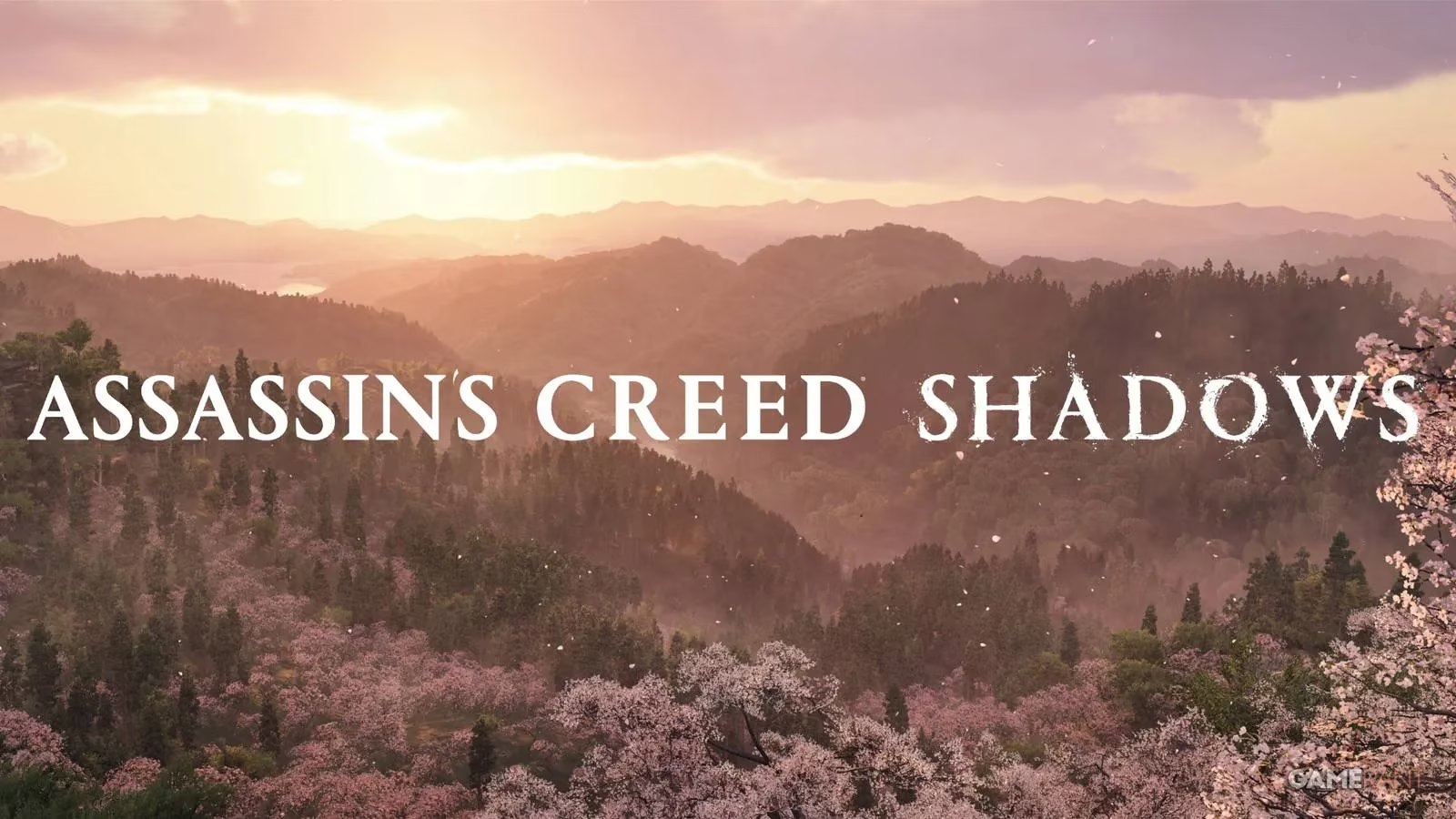
The main storyline revolves around hunting down the enigmatic Shinbakufu organization — a shadowy cabal pulling strings across the land. Now, on paper, the campaign length sounds intimidating: 30 to 50 hours for the critical path, plus another 20 to 30 hours of side content. But here's the genius. The developers carved those hours into bite-sized, self-contained arcs. Each Shinbakufu target is a little epic of its own. First, you have to gather intelligence, maybe dispatch your spy network to sniff out a starting location. Then comes a series of preparation missions — tailing a courier, stealing a shipment, interrogating a snitch. Only then does the assassination window crack open. This entire loop, from the first whisper to the final blade strike, tends to clock in at a wonderfully digestible 60 to 90 minutes.
It's like the game is patting you on the back and whispering, “Hey, you can finish a whole story tonight.” I found myself treating these arcs like episodes of a prestige drama. I'd settle in after dinner, complete one, and feel utterly satisfied. No cliffhanger fatigue, no mid-mission guilt when I had to quit halfway through a fortress assault (we've all been there, let's be honest). The pacing is so organic that it practically establishes a new life rhythm. I started planning my real-world evenings around these in-game hunts, and somehow, that made the whole thing feel less like homework and more like a ritual.
But the coaxing doesn't stop at the mission board. Oh no, the open world itself is a masterclass in gentle temptation. On my way to a story marker in Kyoto, I'd inevitably stumble across a fox guiding me to a hidden shrine, a bandit camp desperate for liberation, or an old monk who wanted me to sit and meditate on a cliff edge. Each distraction felt deliberately placed — a palate cleanser between heavy narrative beats. At first, I fought the urge to wander. I kept telling myself, “Focus, you've got a target to kill.” By the ten-hour mark, I'd surrendered. And I'm so glad I did. Some of my most vivid memories from the game aren't the main assassinations at all, but the random haiku-writing sessions where I had to absorb the scenery before choosing my words. That mechanic alone is a form of enforced mindfulness. You physically cannot rush a haiku.
The dual-protagonist system deepens this philosophy. When I'm playing as the shinobi Naoe, speed is a fantasy. Her entire toolkit revolves around stealth: I need to scout the perimeter, mark every guard, study patrol routes, wait for a cloud to drift in front of the moon, and then move like a whisper. There's a particular rhythm to her gameplay — a creeping, deliberate heartbeat. One wrong step and the whole encampment erupts, but a perfect sequence feels like a slow-motion dance. This isn't a playstyle you can brute-force. The game literally won't let you. And so, without yanking control away, it molds you into a patient player. Even when I switched to the powerhouse Yasuke, who can kick through castle doors, I found myself deploying scouting habits I'd learned as Naoe. The gentleness had stuck.
Looking back, the true magic of Assassin's Creed Shadows lies in how it redefines fulfillment. For years, open-world games have measured progress in map icons cleared and percentage completions. Shadows dared to ask: what if the goal isn't to finish, but to live in the space? Those 60-minute loops, the incidental discoveries, the quiet moments of reflection — they all conspire to make you feel full, even if you only had a single free hour that day. It's a game that respects your time not by being short, but by ensuring every single slice of it feels whole. I've clocked over 80 hours now, and I'm nowhere near the end. And honestly? I'm in no rush at all.
Comments