
How Assassin's Creed Shadows Brought Me to Tears with Its Found Family Story
I still remember the night I first set foot in 16th-century Japan through Assassin’s Creed Shadows. The air was thick with tension, the scent of cherry blossoms mingling with the smoke of burning villages. I had expected a gripping tale of stealth and revenge, but what I found instead was something far more profound—a narrative that clung to my heart long after the credits rolled. At its core, this isn’t just a story about assassins versus Templars; it’s a tender, brutal, and ultimately uplifting exploration of found family.
From the opening hours, the game throws you into chaos. Naoe, a young shinobi, watches her world crumble as Oda Nobunaga’s forces destroy the Iga province and slaughter her father, Nagato. Left for dead, she begins the slow, painful journey of healing—both physically and emotionally. I guided her through those early moments, my own breath catching as a mysterious ronin named Sorin and an orphaned boy called Junjiro pulled her from the brink. At first, I was as wary as Naoe. Who were these strangers? What did they want? Yet as I spent hours with them, watching her wounds mend and her guarded heart slowly open, I realized the game was teaching me something about trust. The bond that formed between Naoe, Sorin, and Junjiro wasn’t forced; it grew naturally from shared meals, quiet conversations under starlit skies, and the unspoken promise of protection. That theme—choosing your own family—became the beating heart of my entire playthrough.
Junjiro, especially, transformed from a scared child into the emotional anchor of the adventure. I still picture him clinging to Naoe’s sleeve as we navigated treacherous forests, his wide eyes full of both fear and fierce loyalty. Here was a boy she had every reason to abandon—after all, Naoe had inadvertently played a role in his father’s death during a chaotic skirmish. But instead, she became his protector, his mentor, his family. I remember one midnight mission where Junjiro risked his life to deliver a vital message to an ally, and my hands literally shook on the controller, terrified I’d fail to keep him safe. Their relationship wasn’t just a side plot; it was the glue that held the entire Brotherhood together. As I rebuilt the shattered Assassin order, each new recruit I found felt less like a gameplay mechanic and more like a new sibling I was inviting to dinner. The hideout swelled with laughter, arguments, and whispered strategies, and I found myself lingering there just to soak in the warmth of this makeshift clan.
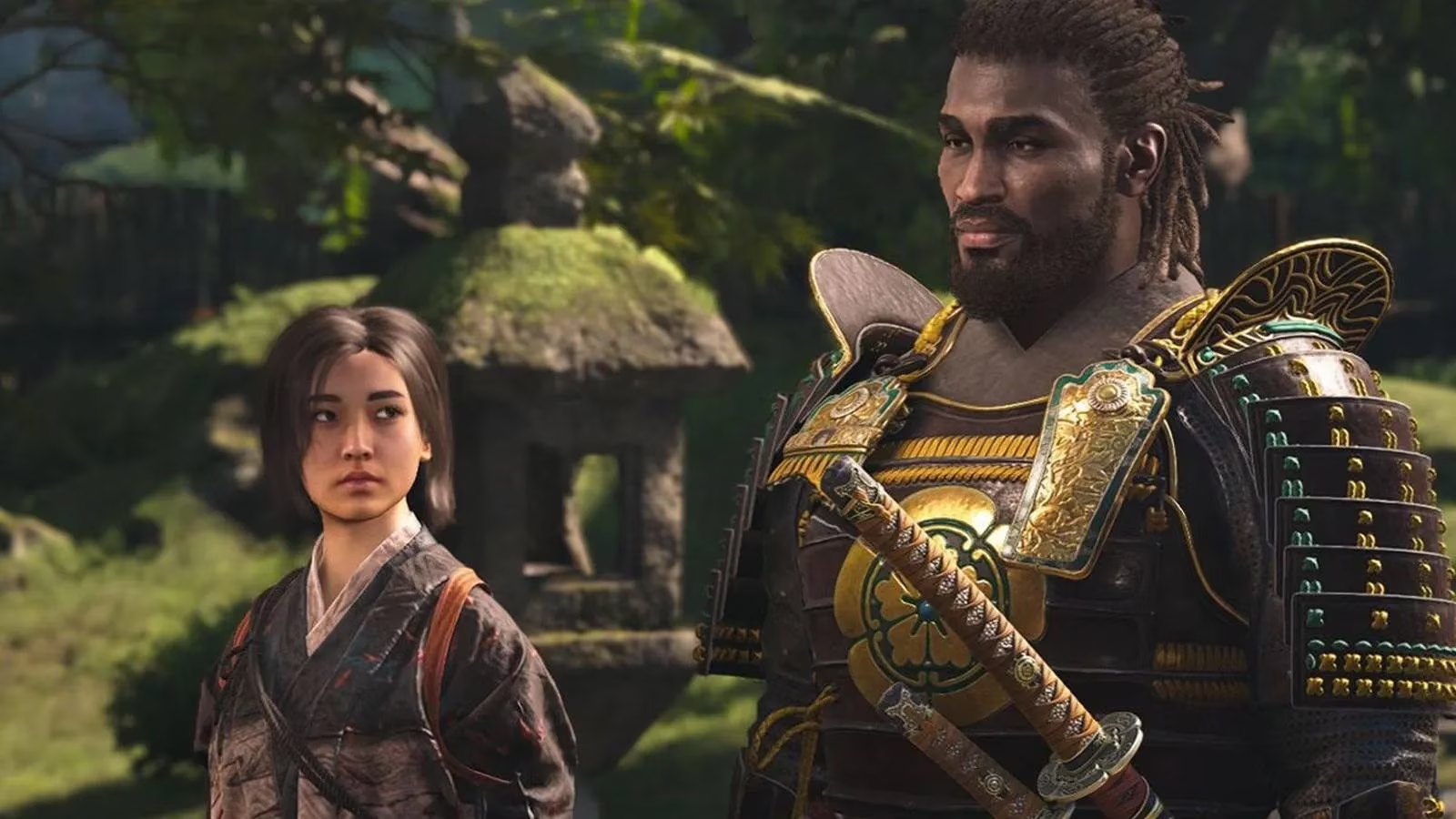
But the game’s most surprising take on found family came through the dual protagonists. When I first switched to Yasuke, the imposing African samurai serving Oda Nobunaga, I felt a jolt of distrust. This man had been on the opposite side of every conflict; he had cut down an Assassin ally right before my eyes during a flashback. Yet Assassin’s Creed Shadows refused to deal in simple heroes and villains. Through a series of tense encounters, Naoe and Yasuke circled each other like wolves, each carrying the weight of their own lost kin. A pivotal moment arrived when Naoe, blade poised to strike, hesitated—guided by Junjiro’s quiet words about forgiveness. I made the choice to spare Yasuke, and from that hesitation bloomed the most unexpected brotherhood I’ve ever experienced in a game.
Together, we hunted the Shinbakufu, two broken souls stitched into something whole. I’d lead Naoe across rooftops to distract a target, then swap to Yasuke for a thunderous, ground-shaking assault. In those moments, I wasn’t just playing two characters; I was witnessing two people who had lost everything rebuild their sense of belonging. They had no blood ties, no shared homeland, no common language at first—only a shared purpose. And yet, when Yasuke risked his life to pull Naoe from a burning temple, or when Naoe stood defiantly between Yasuke and a dozen enemy blades, I felt the weight of a promise heavier than any oath to a creed. They weren’t lovers; they weren’t even traditional friends. They were something rarer—two warriors who chose each other as family against all odds.
Playing this game in 2026, with all its post-launch content deepening side character arcs, I’ve come to appreciate how Assassin’s Creed Shadows subverts the series’ own formula. Yes, the ancient war between Assassins and Templars rages on. Yes, there are hidden blades and leaps of faith. But under all that lies a quiet, persistent question: Who will stand with you when the world falls apart? The answer, as I learned through Naoe’s defiant gaze and Yasuke’s unwavering loyalty, is that family is the fortress we build from the rubble. Every ally I gathered, every campfire story shared, every last stand fought shoulder to shoulder, reminded me that blood means little when hearts beat in unison.
Weeks after finishing the main story, I still return to the hideout just to hear the children’s laughter and see the lanterns flicker above my ragtag family. Assassin’s Creed Shadows gave me more than a power fantasy; it gave me a mirror reflecting the families we find in life—messy, unexpected, and unbreakable. And for that, I will always treasure my journey through feudal Japan.
Comments