
Assassin’s Creed Shadows’ Hidden Blade Is Finally a Precision Tool Again
Stepping into the night as Naoe in Assassin’s Creed Shadows, I felt an old friend slide into my palm as naturally as breathing. The Hidden Blade wasn’t something I had to earn; it was a parting gift from her father, and from the very first moment, it felt like the game’s quiet heartbeat. After years of flirting with RPG stats that made this iconic weapon feel more like a butter knife, Shadows has refocused it into something elegant, deliberate, and utterly satisfying.
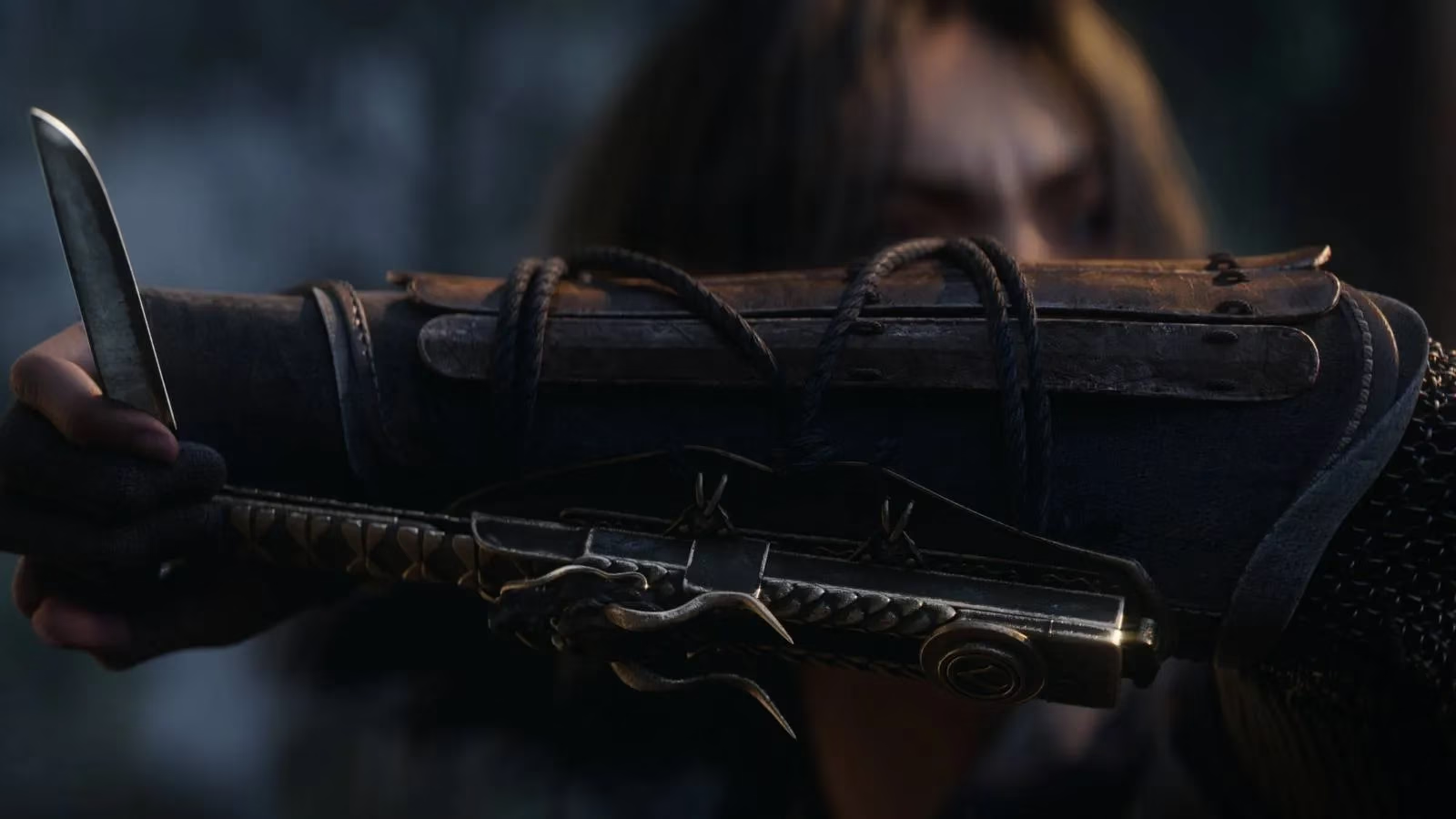
For a long time, the Hidden Blade’s edge had dulled. Back in 2017, Assassin’s Creed Origins ripped up the series’ stealth roots and planted them in a garden of numbers. Suddenly, the blade that once felled any foe with a silent whisper became a damage value that bounced off higher-level enemies. It was like replacing a fencer’s foil with a sledgehammer—effective only if you swung hard enough at something already fragile. Odyssey avoided the blade entirely due to its place in the timeline, and Valhalla’s attempt to stitch it back onto Eivor’s wrist felt more like a concession, offering an optional instant-kill toggle that acknowledged the weapon’s lost identity. In those games, I often forgot the Hidden Blade was even there.
Assassin’s Creed Shadows treats the blade differently. Instead of adhering to a raw damage model, its stealth assassinations operate on a health-block system—a quiet revolution that turns every encounter into a puzzle of opportunity. Each enemy has a visible grid of health blocks above their head, and as you draw near, the portion of those blocks you’ll shear away is illuminated. It’s like watching a maestro cue the strings just before a symphony’s climax; you know exactly which notes you’ll play, and the silence that follows is deafening. If an enemy has fewer blocks than your assassination can remove, they fold instantly. If they have more, they’re left gasping, wounded but not dead. The Hidden Blade becomes a surgeon’s scalpel in a world of machetes—it doesn’t overwhelm, it incises with terrifying precision.
This system does more than just rebalance power. It rewires how you move through the world. In older titles, a detection usually meant failure or a frantic escape. Here, it’s an invitation to read the room. I found myself circling camps not just for the safest route, but for the most lethal one, mentally tallying which samurai’s health blocks could vanish in a single strike and which would require a follow-up. The blade’s glowing indicator acts like a contract you sign before attacking—there’s no guesswork, only commitment. This clarity merges with Shadows’ improved stealth suite, where shadows and noise aren’t binary switches but gradients you can manipulate. The result is a dance where the Hidden Blade is the lead partner, guiding your every move without ever stepping on your toes.
What’s remarkable is how this approach sidesteps the old dilemma of feeling either omnipotent or impotent. In Origins, I’d routinely avoid assassination attempts on beefy captains because the math looked shaky. In Shadows, that same captain’s health-block bar might show only a sliver remaining after my initial strike, turning him into a desperate beast I could finish with a swift combat maneuver. The game doesn’t punish you for using your signature weapon; it encourages you to respect it. Even bosses, who often laugh off a single assassination, are left genuinely staggered—a narrative beat that reminds you the blade still carries weight even when it can’t end a fight on its own.
Looking back from 2026, two years after Shadows redefined the franchise again, it’s clear this health-block design was a turning point. It honored the fantasy of the Hidden Blade without letting it become a cheat code, and it demanded that players think like actual assassins: cold, calculating, and aware of exactly how much killing their weapon can accomplish. I’ve never seen a mechanic that so elegantly transforms a UI element into a storytelling device, and I doubt I will again soon.
Comments