
Assassin's Creed Shadows Stealth Soars While Parkour Trips Over Its Own Feet
As of 2026, anyone still expecting Assassin's Creed Shadows to deliver both breathtaking parkour and best-in-class stealth might feel like a chef tasting a Michelin-starred soup only to discover the spoon is a bent twig. The game’s renewed obsession with shadows, patience, and guard-filled courtyards has produced arguably the finest stealth loop in the franchise. Yet the cost is steep: the once gravity-defying parkour system now handles like a caffeinated chicken trying to navigate a freshly mopped floor. In other words, for every silent takedown that makes a player feel like a ghost, there is a rooftop leap that makes them feel like a confused tourist.
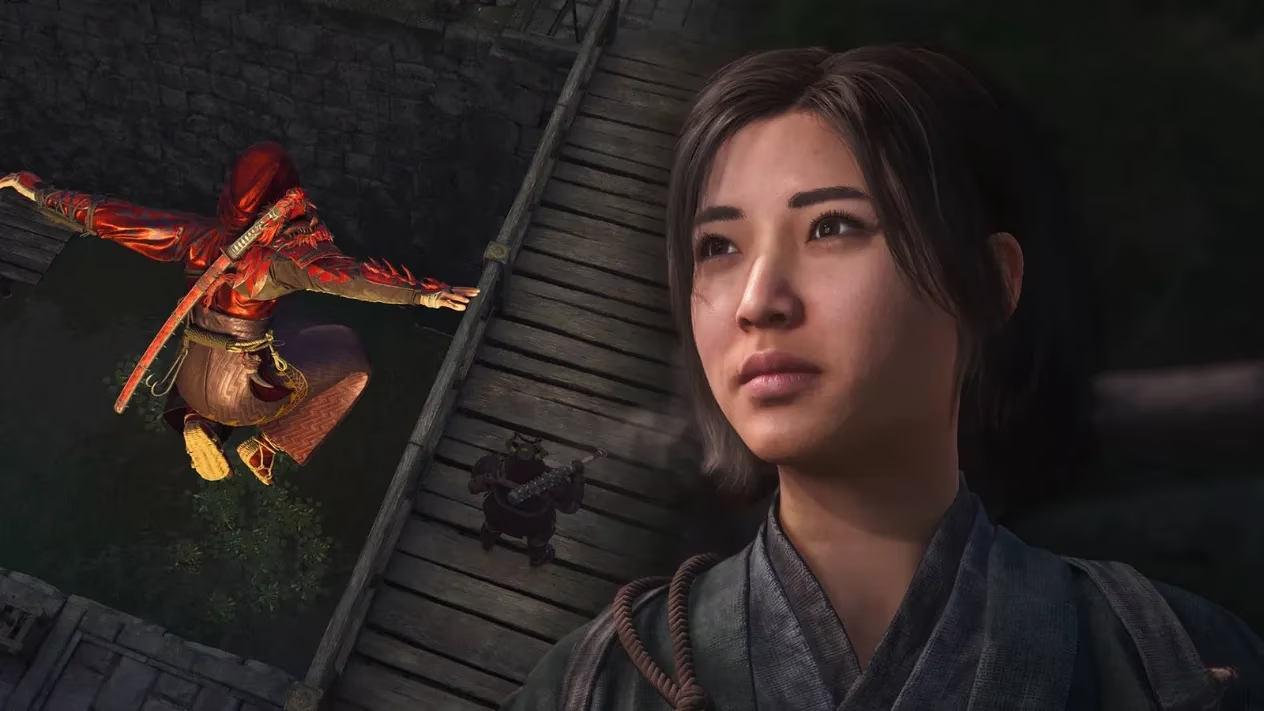
A Grounded Design Philosophy
The rooftops of feudal Japan remain plentiful, and traditional architecture—sloped temple roofs, wooden watchtowers, stone walls—offers plenty of visual invitation for vertical play. However, Assassin's Creed Shadows deliberately keeps players closer to the dirt. The addition of a prone position is not just a neat trick; it is a philosophical statement that the ground is now more valuable than the sky. Instead of encouraging players to climb higher, the game rewards them for crawling through grass, slipping under floors, and remaining eye-level with their enemies.
This grounding comes at the expense of freedom. In earlier entries, a player could scale almost any surface that looked climbable, and in some cases surfaces that absolutely did not. Shadows introduces a stricter bookkeeper to that contract. Rock faces with tempting handholds often repulse would-be climbers like a bouncer at a members-only hot spring. Even familiar ledges can lead to awkward falls because judging leaping distance is less precise than a pack of moody cats deciding whether to sit in a lap. The result is one of the most restricted parkour systems in the modern series.
| Element | Pre-Shadows Expectation | Shadows Reality |
|---|---|---|
| Climbing scope | Almost any visible handhold | Selective, often denied |
| Vertical mobility | Glorious roof-running | Low-profile traversal |
| Stealth role | Optional flavor | Main course |
| Enemy behavior | Forgetful extras | Tenacious hunters |
Stealth Gets the Crown It Always Begged For
While parkour sulks in the corner, stealth finally gets the royal treatment it has begged for since the first hidden blade unfolded. Enemies in Assassin's Creed Shadows are more alert, more suspicious, and far less willing to assume that a falling body was just heavy rain. Once alerted, they pursue longer and check hiding spots with a paranoia that borders on inspiring. Pulling off an assassination on an aware target is significantly harder, meaning players must actually study patrol routes, weapon types, light sources, and escape options.
This is not the old “crouch in a bush until everyone forgets” routine. It is closer to a porcelain chess match held inside a live beehive. One loud footstep can turn a quiet pagoda into a shouting contest, and one poorly chosen kill can chain into a very bad evening. Tools such as shadows, darkness, distractions, and the prone stance become essential rather than just decorative. The AI overhaul forces deliberate, thoughtful movement, which is exactly what the series needed after years of turning every mission into a sword-swinging mosh pit.
-
✅ Guards communicate, coordinate, and search longer.
-
✅ Alerted enemies resist easy one-hit assassinations.
-
✅ Light, sound, and line-of-sight matter again.
-
✅ Success demands planning, not just reflexes.
Even Assassin's Creed Mirage, which was billed as a love letter to early games, only cracked the stealth door open. Assassin's Creed Shadows kicks that door off its hinges and replaces it with a tripwire. By 2026, it remains the high-water mark for stealth in the franchise, precisely because it refuses to let parkour serve as an easy escape hatch.
Is the Trade Fair?
Some longtime fans will understandably mourn the old parkour—the joyful, roof-skimming ballet that once defined the series. In Shadows, that ballet has been downgraded to a cautious shuffle, and no amount of flashy new animations can hide the limp. Yet the trade is logical. A stealth-first design cannot allow players to vanish upward every time trouble appears; the tension would evaporate faster than a snowflake in a blacksmith’s forge. By pruning the parkour branch hard, the developers let the stealth branch grow thick enough to carry the entire game.
Players who insist on scaling every pagoda like an overcaffeinated ibex will leave disappointed. Those who learn to move low, read the dark, and treat each shadow as a second skin will discover the most tense and satisfying assassin experience the series has produced in years.
Comments