
Assassin's Creed Shadows' Night Sky Sparks Debate Over Astronomical Accuracy and Animus Lore
In the sprawling open world of Assassin's Creed Shadows, players are often encouraged to look down at the intricate details of feudal Japan. However, a recent discovery has prompted the community to look up, igniting a fiery debate about the very stars that illuminate the game's night sky. A player's observation of the celestial display, shared on Reddit, has divided opinions on whether Ubisoft's depiction is a masterstroke of astronomical realism or a curious artifact of the series' signature Animus technology. This discussion serves as a microcosm of the game's reception—a title that, despite pre-launch controversies, has been warmly embraced for its immersive depth and hidden layers waiting to be peeled back.
The Spark of Celestial Controversy
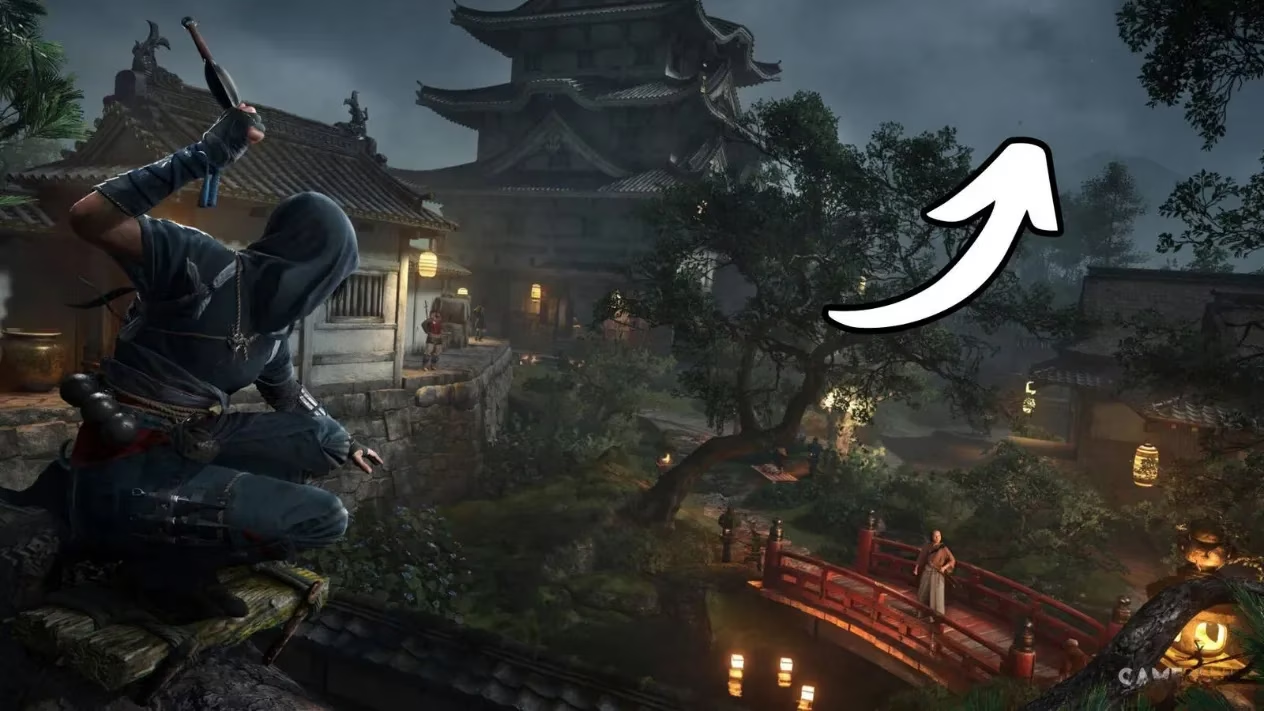
The debate was ignited when Reddit user VoidzModerator shared screenshots from Assassin's Creed Shadows, showcasing the dense, star-studded sky above the shinobi Naoe. The images highlighted clusters of golden stars peppering the inky darkness, with wispy clouds drifting past. The original poster questioned if these clusters were meant to represent real-world galaxies, expressing a sentiment that, while visually striking, the star system felt "ridiculous" compared to the more aesthetically pleasing skies of older series entries. This post acted like a stone dropped into a still pond, sending ripples of discussion throughout the community.
A Galaxy of Opinions: Realism vs. Simulation
The community's response was far from monolithic. It fragmented into several distinct camps, each defending their perspective on the digital cosmos:
🔭 The Realism Advocates: Many players rushed to the game's defense, arguing that the sky is a faithful representation. They noted that viewing the heavens from a remote, pre-industrial setting like Shadows' Sengoku-period Japan—free from modern light pollution—would indeed reveal a breathtaking tapestry of stars. For these players, the sky is not an error but an achievement, a canvas of spilled diamond dust against the void. Some even drew comparisons to other open-world titans, praising The Witcher 3: Wild Hunt for its accurate Milky Way while affirming Shadows' own commitment to a believable nightscape.
💻 The Animus Theorists: A compelling counter-argument emerged from lore enthusiasts. Assassin's Creed Shadows introduced the Animus Hub, a new feature leaning into the series' foundational concept of reliving memories through a virtual reality machine. These Redditors posited that the night sky players see is not Japan's sky, but a rendering within the Animus simulation. The stars, therefore, could be interpreted as part of the simulation's code—a visual representation of the data-stream background, making the sky a glitchy, beautiful hologram projected by the machine. This theory reframes the debate from one of historical accuracy to one of narrative consistency.
🎨 The Artistic License Camp: Another group took a middle path, appreciating the sky purely for its visual drama and contribution to the game's atmosphere. For them, whether scientifically precise or not, the sky succeeds in making the world feel vast, ancient, and mysterious.
Beyond the Stars: A World of Hidden Details
This stellar debate has inadvertently shone a light on the sheer density of detail packed into Assassin's Creed Shadows. The night sky is merely one thread in a richly woven tapestry. Players have been equally impressed by:
-
Dynamic Weather Systems: The game's weather isn't just backdrop; it directly influences the world. Realistic snow accumulates and affects travel, while rain changes the behavior of both flora and fauna.
-
Living World Reactions: NPCs exhibit nuanced behaviors that reinforce the setting. Notably, citizens will often stare at the samurai Yasuke with awe or caution, while paying less attention to the shinobi Naoe—a subtle but powerful way of showcasing the social hierarchy and Yasuke's unique status as a legendary foreign-born warrior.
-
Environmental Storytelling: From the layout of hidden camps to the wear on ancient tools, the environment silently narrates stories of the tumultuous Sengoku period.
The Verdict from the Clouds
As of 2026, the debate over Assassin's Creed Shadows' sky remains a vibrant, unresolved community conversation. It highlights a fascinating aspect of modern game discourse: the intersection of technical artistry, scientific plausibility, and narrative framing. Whether viewed as a historically accurate panorama, a clever Animus artifact, or simply a constellation of coded light points, the night sky has proven to be more than just a pretty background. It is a focal point that demonstrates how a single visual element can deepen player engagement, encouraging them to question, explore, and uncover the many layers of a virtual world. In the end, the controversy itself is a testament to the game's ability to captivate and inspire its audience, proving that sometimes, the most interesting discoveries are the ones waiting above, in the digital firmament.
Comments