
Assassin's Creed Shadows' Dual-Protagonist Gamble: A Flawed Masterpiece That Splits the Series' Soul
Let me tell you something, as someone who has lived and breathed the Animus for decades, the year 2026 has brought us a game that is both a breathtaking spectacle and a profound identity crisis. Assassin's Creed Shadows landed with the force of a Yasuke war cry and the subtlety of a Naoe assassination, promising the ultimate fusion of everything we've ever loved about the franchise. But can a game truly be two things at once without tearing itself apart? I've spent countless hours mastering both the ghostly shinobi and the unstoppable samurai, and I'm here to scream from the rooftops of Kyoto: this ambitious structure is a double-edged sword that has irrevocably cut into the very DNA of Assassin's Creed.
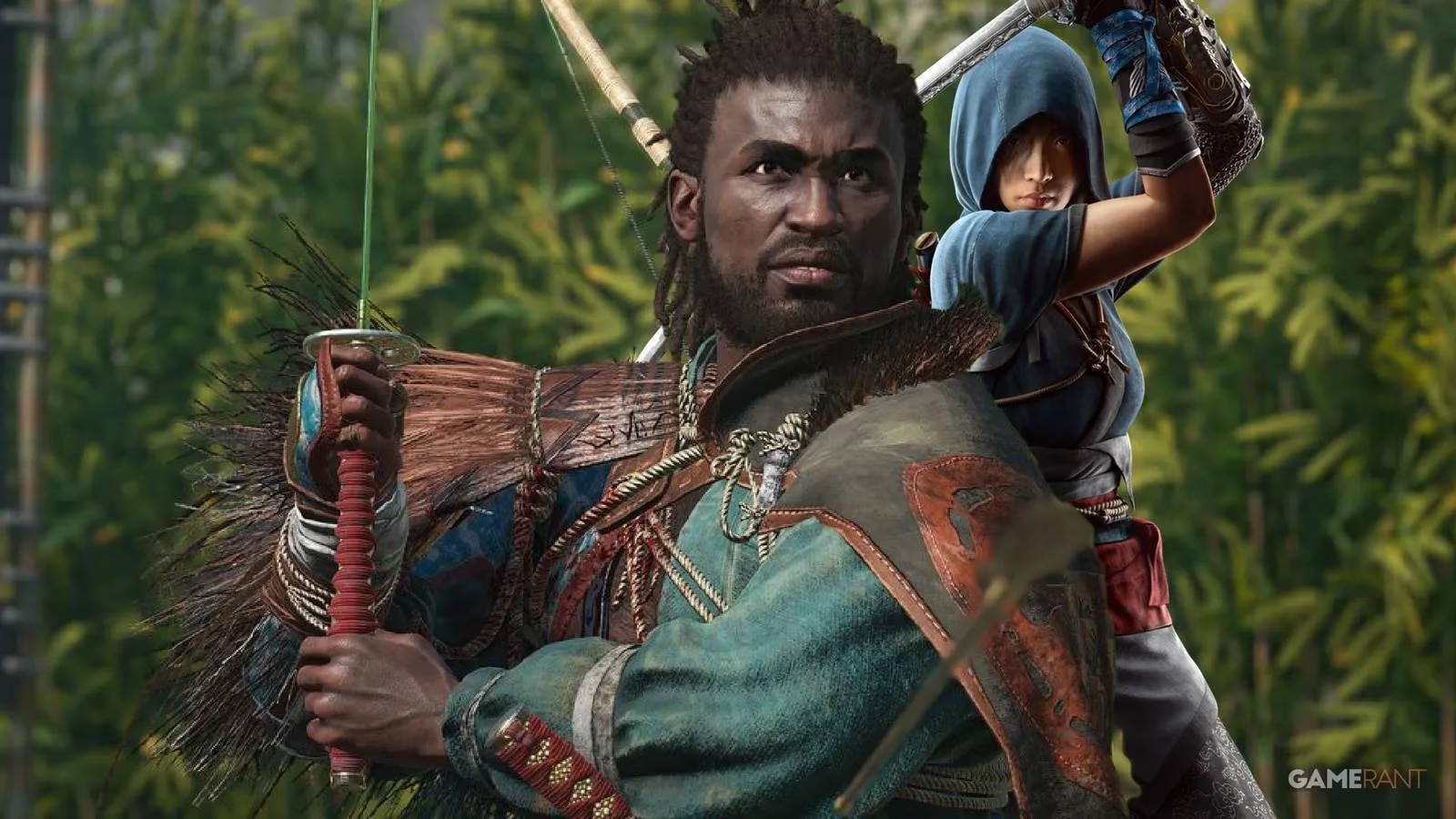
🔥 The Duel of Identities: Stealth vs. Steel 🔥
The sheer audacity of Ubisoft's design is undeniable. On one hand, you have Naoe. Playing as her is like slipping into a cherished, worn-in leather glove from the golden age of the franchise. Her world is one of:
-
Vertical mastery: Scaling pagodas and castle walls with a grace that would make Ezio weep with joy.
-
Tactical precision: Planning every move, using smoke bombs and distractions like a conductor leading a silent symphony of death.
-
Methodical pacing: Missions that demand patience, observation, and that perfect, singular strike. It's Brotherhood reborn in 16th-century Japan!
And then... you switch to Yasuke. The screen shakes, the music swells, and subtlety is thrown out the window. His philosophy is pure, unadulterated force:
| Naoe's World | Yasuke's World |
|---|---|
| Shadows and whispers | Roars and clashing steel |
| Single-target elimination | Crowd-control devastation |
| Avoidance is victory | Confrontation is glory |
Switching between them isn't just changing a character model; it's swapping entire game genres! One moment I'm a ghost, the next I'm a battering ram. The cognitive whiplash is real, people!
❓ The Narrative Schism: Can a Story Serve Two Masters? ❓
Here's the million-credit question: How do you craft a cohesive narrative when your two leads operate on fundamentally opposing philosophies? The answer, painfully clear after finishing the campaign, is that you can't—not without serious compromise.
Naoe's story arc is one of secrecy, honor from the shadows, and the weight of the Hidden Blade's creed. Yasuke's journey is about forging a legacy in the open, through strength and undeniable presence. The game's plot contorts itself into narrative knots trying to justify why these two would ever work together, and more importantly, why I should constantly interrupt one's journey to play the other's.
Remember the laser focus of Assassin's Creed II? Every mission, every location, was built to showcase Ezio Auditore da Firenze. The world was his playground. Shadows tries to build a world that is both a ninja's paradise and a samurai's battlefield, and in doing so, it creates a setting that feels oddly generic for each character individually. The story lacks the singular, driving identity that made the best entries so memorable.
⚔️ The Player's Dilemma: Freedom or Friction? ⚔️
As a veteran who yearned for a "return to form," my time with Naoe was pure bliss... until the game insisted I swap to Yasuke to break down a fortified gate or fight a mandatory open battle. That seamless stealth immersion shattered in an instant! Conversely, my friends who joined the franchise with Odyssey's epic conquest battles would groan when forced into a lengthy Naoe infiltration mission to progress the story.
Shadows operates on a dangerous assumption: that all players want both experiences equally. But what if I just want to be a ninja? Or what if I only crave the samurai's power fantasy? The game's structure often feels less like player choice and more like mandatory genre-hopping homework. In trying to be the ultimate crowd-pleaser, it risks creating moments of frustration for everyone.
-
For the Old Guard: "Just let me hide in this bush and plan my route! Why are you making me fight ten guards head-on?!" 😫
-
For the RPG Era Fans: "I have a legendary katana! Why do I need to sneak past these peasants?" 😠
🗺️ The Shadows Precedent and Ubisoft's Crossroads 🗺️
This is the real legacy of Shadows in 2026. It's not just one game's experiment; it's a potential blueprint for the future, and that's terrifying. With Ubisoft's rumored "nine games in six years" plan in full swing—including Invictus, the Black Flag remake, and more—Shadows could signal a direction where every mainline title feels obligated to cram in multiple playstyles to check boxes.
But wait! What if the solution has been staring us in the face all along?
Look at the upcoming slate:
-
Assassin's Creed Hexe: Rumored to be a darker, more horror-focused experience.
-
Assassin's Creed Invictus: A dedicated multiplayer title.
-
Assassin's Creed Remakes: A chance to purely revisit classic stealth.
Why can't this be the model? Let different games explore different facets of the creed with full commitment! Give us a mainline title that is unapologetically a pure stealth experience, dripping with social stealth and assassination puzzles. Then, give us another that is a full-blown historical action-RPG. The brand is big enough to support specialized experiences.
Assassin's Creed Shadows is a monumental, beautiful, and technically impressive game. It contains some of the best ninja gameplay I've ever experienced and some of the most satisfying combat since Valhalla. But by marrying these two souls in a single package, it has highlighted a fundamental truth: sometimes, more is less. The dual-protagonist structure, for all its initial wow factor, ultimately creates a friction that prevents either identity from reaching its full, legendary potential. It's a glorious, flawed experiment that should be admired, learned from, and then allowed to remain a unique, singular chapter—not the template for the future of the Brotherhood.
Comments